Hidden Storage Ideas For Small Spaces That Work
Small rooms don’t actually lack storage space. They lack visible storage space. The floor under your bed, the back of your sofa, the inside of that footstool you’re resting your feet on — all of it is storage waiting to happen. The trick is choosing pieces that hide clutter inside everyday furniture, so your small space looks calm without asking you to own less.
Below are ten hidden storage ideas that genuinely work in real homes. Everything here is renter-friendly, needs no drilling into walls or big renovations, and starts from one simple rule: if it sits in your room anyway, make it store something too.

1. Swap the coffee table for a storage ottoman that doubles as a blanket box.
A traditional coffee table only gives you a surface. A storage ottoman gives you a surface plus a hollow inside big enough for throws, board games, or the remote-collection chaos. Sit on it, rest your feet on it, flip the top and stash the mess in ten seconds when guests knock. It looks like soft furniture and works like a chest.
Measure your current table before you shop, and pick an ottoman that’s about the same footprint so your walking paths don’t shrink. Renters, this is a zero-commitment swap: no tools, no holes, just carry the old table into the corner and carry the ottoman in.

2. Choose a bed with built-in drawers (or slide boxes under the bed).
The space under a bed is usually the biggest dead zone in a small bedroom, and built-in drawers turn it into the equivalent of an extra dresser. If buying a new frame isn’t in the cards, low fabric boxes on castors slide under almost any bed and pull out just as easily. Seasonal clothes, spare bedding, wrapping paper — all of it lives under you, invisibly.
Check your bed’s clearance first: most under-bed boxes need 15–20 cm of height. Dust is the only real enemy here, so line boxes with a quick wipe twice a year. Nothing to drill, nothing to damage — landlords never even notice.

3. Pick a coffee table or bench with a lift-up lid.
Some coffee tables and entryway benches look completely ordinary until you lift the top. Inside there’s a deep well for cushions, charging cables, kids’ toys, or anything else that turns a tidy room into a disaster in one afternoon. A bench version pulls double duty at the foot of a bed or by the front door for shoes.
Test the lid in the shop if you can — cheap hinges sag after a year. For renters and small rooms, a narrow bench with a lift-up lid works at the end of a hallway or under a window without blocking anything. When closed, it’s just a bench. That simplicity is the whole point.
4. Use a hollow stool or pouf for small items.
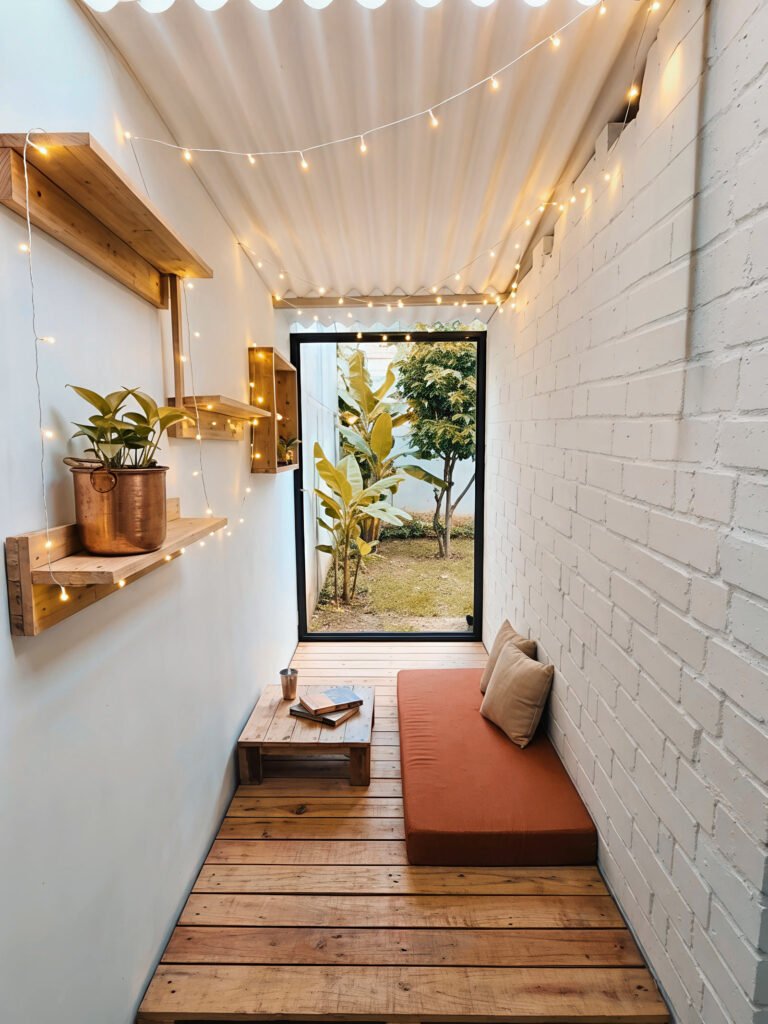
Poufs and hollow stools are the sneakiest storage in this list. They read as pure decoration, weigh almost nothing, and inside there’s room for headphones, charging bricks, sewing kits, or the nail polish that always migrates around the house. Pull one up for extra seating when friends visit; the stash inside stays secret.
Because they’re light and movable, they’re perfect for renters — they come with you to the next flat. Aim for ones with a removable top rather than a zip that fights you, and keep heavy items out so the pouf stays easy to lift.

5. Slide a slim console behind the sofa with baskets underneath.
The 25–30 cm gap behind a sofa is wasted space in most flats, and a slim console table turns it into a storage strip without eating floor area. Run fabric baskets or low boxes underneath for shoes, pet toys, or the throw blankets that live on the sofa. The console top becomes a home for a lamp, a charging station, and a stack of books.
Measure the gap before you buy — sofas vary, and “slim” consoles range from 20 to 35 cm deep. Leave a finger’s width behind the sofa so cushions don’t knock anything off, and anchor the console to the wall if you have kids or pets who lean.
6. Use hollow lidded baskets as side tables.
A sturdy lidded basket next to the sofa reads as a side table and hides remotes, magazines, chargers, and the miscellaneous “I’ll deal with it later” pile. Choose ones with a flat lid that takes a cup of tea safely, and line the inside with a bag so small things don’t slip into the weave.
If you need it to work harder, put a round tray on top to stabilise cups and lamps, and keep a foldable tote inside for the day you need to carry the mess elsewhere. It’s storage, a table, and a laundry-adjacent helper in one.

7. Add a headboard with a shelf or pockets.
A headboard with a built-in shelf turns the wall behind your pillow into a nightstand you never have to dust around. Books, glasses, a phone charger, and a glass of water all get a home without a separate table eating floor space. Fabric pocket organisers do the same job on any existing headboard — slide one between the mattress and the frame.
Check that shelves are deep enough for what you’ll put on them (10–12 cm works for most), and keep anything heavy low. If the headboard is freestanding rather than wall-mounted, make sure it’s stable before you load it up.

8. Install a fold-away desk that hides work items after hours.
Working from the kitchen table means the laptop, charger, and paperwork colonise the room all evening. A wall-mounted fold-away desk closes over everything when you’re done, turning work clutter into a flat panel that reads as art or a mirror. Inside the lid, keep a slim tray for pens and a cable clip for the charger.
Renters can use a freestanding folding console instead — same idea, no screws. Keep the surface clear with a “one inbox” rule: only the current project lives there, everything else goes to its hidden home.

9. Choose a TV console with closed doors to hide cables and remotes.
An open TV stand is a magnet for visible cables, game controllers, and remotes. A console with closed doors hides the lot — and keeps dust off electronics at the same time. Drill one cable hole in the back panel if there isn’t one, and use a short power strip inside so only one cord leaves the unit.
Ventilation matters: leave a few centimetres behind the console and don’t block any vents on the devices themselves. Closed doors don’t mean no airflow if you plan for it.

10. Label everything — hidden does not mean forgotten (6-month check).
The one risk of hidden storage is forgetting what lives where. Keep a simple list on your phone — one line per hiding place, updated when you move things. When everything is invisible, the list becomes your map, and tidy-up sessions take minutes instead of an afternoon.
Twice a year, open every hidden spot and pull out what you no longer use. Hidden storage should hold things you actually need; anything else just becomes clutter you can’t see. The six-month check keeps the system honest.

Final Thoughts
Hidden storage works best as a system, not a single purchase. Start with the piece that bugs you most — the messy TV corner, the overflowing wardrobe — and add one hidden solution at a time. Over a few weeks, the room starts to feel bigger without a single thing being thrown away. Cozy and organised are not opposites; in a small space, they’re the same project.